

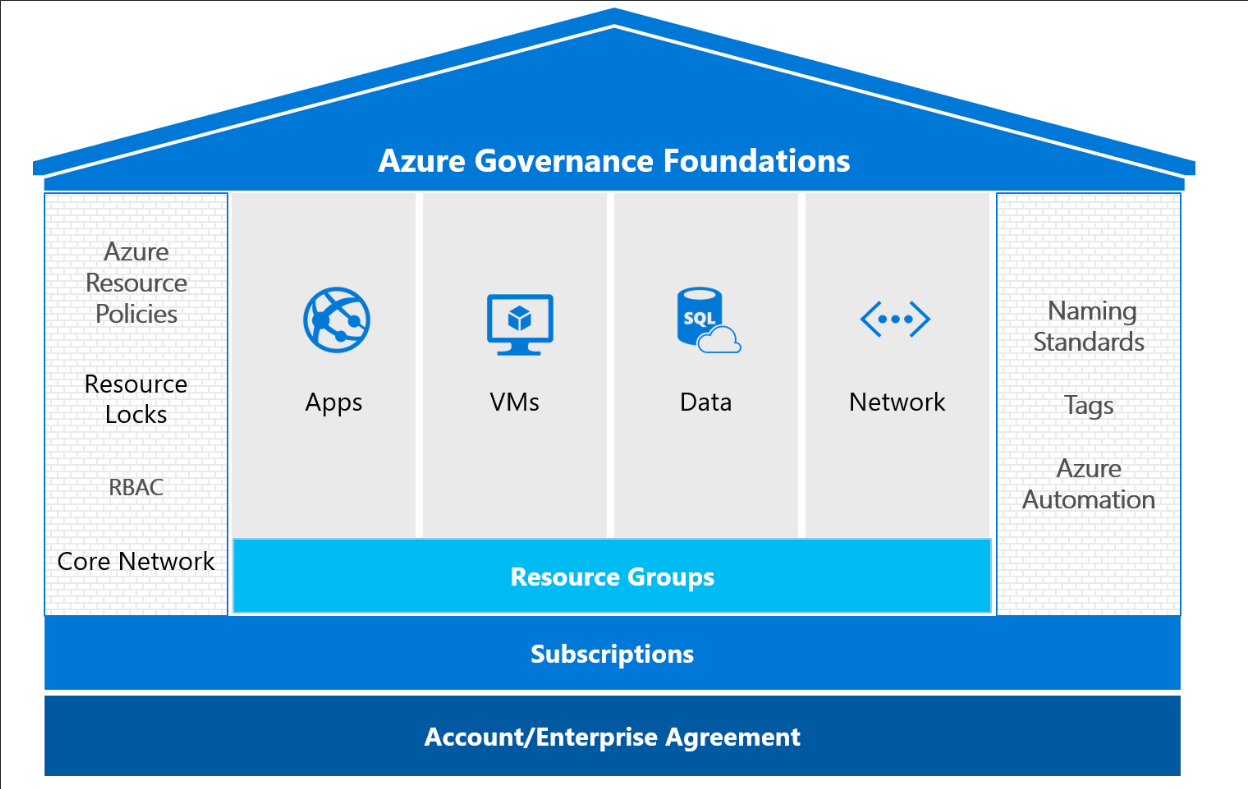
Like a house, a cloud platform needs its foundations before its furnishings. The useful outcome is a set of owned decisions and acceptance checks, not a requirement to deploy every possible service.
1. Organisation
- CAF and landing zones: decide who owns the platform and how workload teams onboard. Use the Cloud Adoption Framework and landing-zone introduction.
- Management groups: decide which subscriptions share controls and who may change the hierarchy. Check inherited Policy/RBAC before moving subscriptions.
- Subscription lifecycle: record billing ownership, onboarding, suspension and decommissioning responsibilities.
2. Governance
- Policy: choose the controls, scopes and rollout approach; understand definitions versus assignments before enabling Deny.
- RBAC: decide who needs which operation at which scope; use groups and inspect built-in roles rather than assigning Owner by habit.
- Naming: agree on readable examples and actual service constraints using the naming tool.
- Tags: choose accountable owner, environment and cost-allocation fields; check tag support before enforcing a blanket rule.
3. Platform
- Automation: decide how changes are reviewed, planned and promoted; use a protected identity and OIDC federation.
- Network and DNS: choose address space, routing, resolver ownership and private/public access requirements. Start with DNS fundamentals and the subnet calculator.
- Compute choices: VMs, NAT Gateway, hub-and-spoke and other components depend on the workload. A foundation decision is required; deploying each component is not universally required.
4. Operations
- Monitoring and response: agree who receives alerts, how logs are retained and how an incident is handled.
- Recovery: record backups, restoration ownership and actual restore-test results.
- Cost: establish budgets, ownership and review cadence using the cost checklist; a budget alert is not a hard spending cap.
- Evidence: keep decisions, approved exceptions and validation results in the platform repository.
Copy or print the readiness checklist
The article's Share action includes Print. This record is a starting template, not evidence that a platform is compliant.
text
Workload and accountable owner:
Subscription / management-group placement:
Identity / least-privilege role scope:
Policy baseline / rollout / exception owner:
Naming and mandatory tags:
Network / DNS / public-access decisions:
Reviewed deployment and recovery process:
Monitoring / incident / cost ownership:
Acceptance tests and actual results:
Open decisions before onboarding:
Optional inventory aid: AzGovViz can help review hierarchy and governance; it does not make the decisions for you. No platform deployment or validation result is recorded by this checklist.